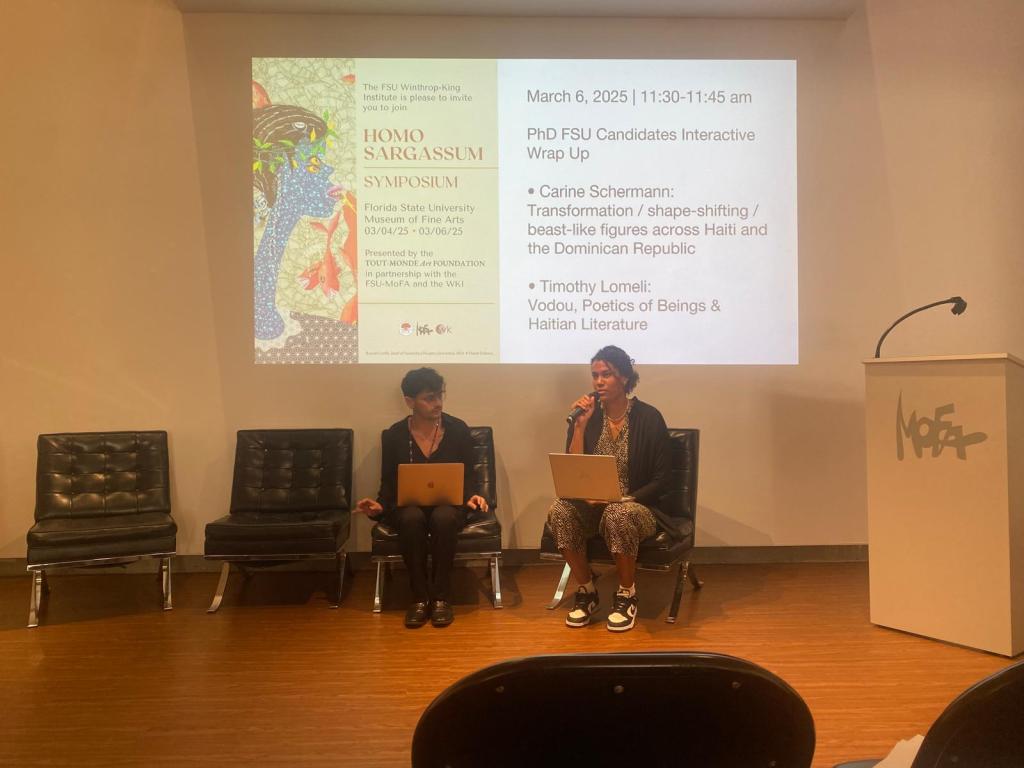
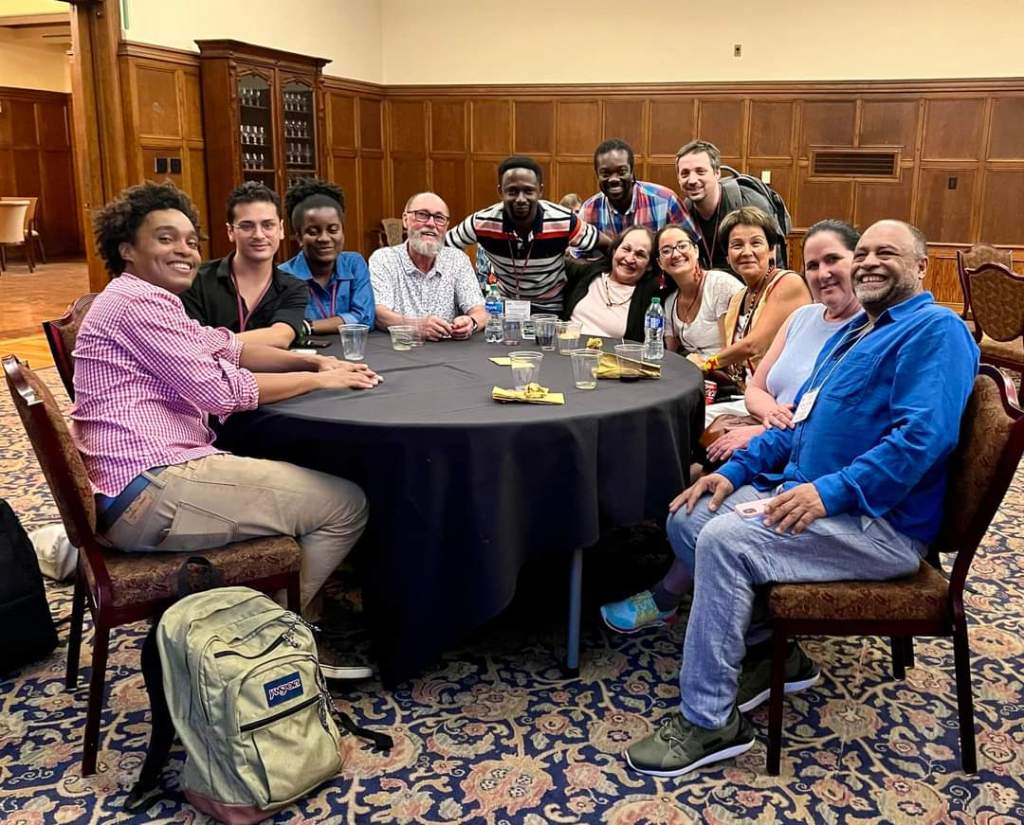
“VODOU AS A POETICS OF BEING IN HAITIAN LITERATURE” (INVITED) – Homo Sargassum Symposium, 6 March 2025
In this brief presentation, I will speak about Vodou, its relationship to water and the lwa Ezili and Lasirenn. I work mainly on what I call “Vodou poetics” and how dreams, objects, scents, and the lwa manifest in literature. Furthermore, I will demonstrate the relationship between Vodou & Vodou poetics, personal values, and personhood with brief examples from novels by Kettly Mars, Kasalé (2003), Heure hybride (2005), Fado (2006), & Aux frontières de la soif (2013).
“AFROPEAN BLUES: MUSIC AND AFROPEAN IDENTITY IN LÉONORA MIANO’S BLUES POUR ÉLISE” – Modern Languages Graduate Student Conference, 27 February 2025
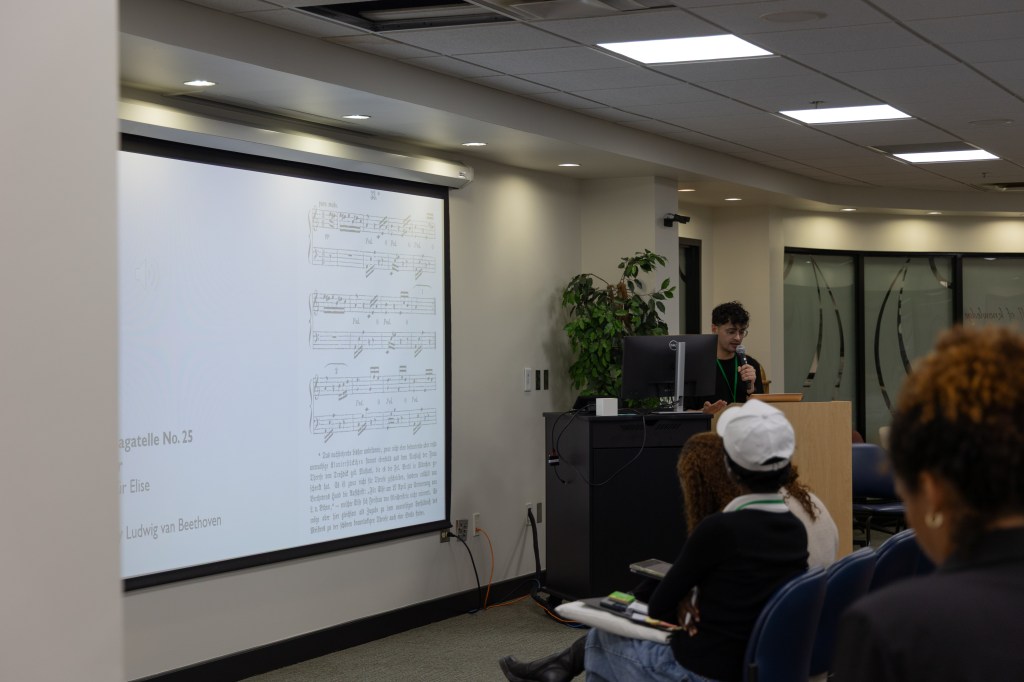
Music is at the heart of Léonora Miano’s 2010 novel, Blues pour Élise. In this text, Miano, a Cameroonian author, examines what it means to be African and Afro-descended peoples and living in a colonial space–in this case, France. The title, Blues pour Élise, which becomes a neologism that combines the genre of blues music, a historically black music genre, with “pour Élise,” a reference to the classical composition by Beethoven, “Für Elise.” The novel follows a friend group of “Afropean” people trying to navigate love and life in Paris, and their struggles to understand their relationship to their ancestral and French identities. Throughout every chapter, characters reference important songs from Black artists in jazz, blues, & R&B, and at the end of each chapter, Miano includes an “ambiance sonore” or a playlist intended to accompany the reader’s experience of the chapter. This paper will examine the role of music in this novel through theories of intermediality. Steven Paul Scher, in “Music in Literature,” writes that the appearance of music in literature is fundamentally different from music itself because almost all elements that make it music (melody, lyrics) are generally absent from the text (180). So, the reader has to either be familiar with the music or listen to it to understand the ambiance and feelings each character tries to express. Miano’s inclusion of music in her text underscores its importance in expressing this hybridity and how Black music genres, regardless of the music’s origins–whether in the US, France, or elsewhere–can uniquely express identities historically marginalized in colonial spaces of power.
“COMBATTING COLONIAL TRAUMA IN GISÈLE PINEAU’S LA VIE PRIVÉE D’OUBLI” – SOCIETY FOR POSTCOLONIAL FRENCH STUDIES, LONDON, ENGLAND, 16 November 2024
Does trauma ever leave us? How do generations after us deal with the former generation’s trauma? How does this affect an ongoing experience of oppression? Gisèle Pineau’s 2024 novel La vie privée d’oubli deals with these questions. The characters are haunted by a colonial past that they themselves did not experience, an ancestor, Agontimé, who took her life to escape a life of enslavement, but whose child lived on and passed down this traumatic memory. While this memory is shared among almost all of the characters in the novel, in this paper, I will focus on Yaëlle who begins to see visions of this aforementioned ancestor and unravels secrets of the past. In Paris, Yaëlle is diagnosed with psychological problems. Still, this diagnosis is contested when her family realizes she has actual knowledge of things and people that she could not otherwise know.
I will analyze this experience of historical trauma and recovery through Glissantinian and psychological theories, like epigenetics, as well as Guadeloupean epistemologies, to demonstrate that in Pineau’s text, and for people who grow up in societies that impose different belief systems, it is necessary to reconcile those imposed with those inherited. I aim to demonstrate that ancestral belief systems are essential to confronting enduring colonial realities in places like Guadeloupe, which remains under French control, and even in places like Paris, where people from different cultures have to live and adapt to systems in which they do not fully believe. Yaëlle’s family’s acceptance of her and support of one another ultimately destabilize hegemonic definitions of insanity that underlie and reinforce colonial oppression.
 Timothy Lomeli